Introduction
When most people think of WebAssembly (Wasm), they think of games and graphics applications running in web browsers. While this was Wasm’s origin, the technology has evolved far beyond the browser. Today, WebAssembly is revolutionizing server-side computing by offering unprecedented performance, portability, and safety.
As Docker founder Solomon Hykes famously stated:
“If Wasm+WASI existed in 2008, we wouldn’t have needed to create Docker. That’s how important it is. Webassembly on the server is the future of computing.”
This insight captured the essence of Wasm’s potential to transform how we build and deploy server applications.
The Evolution of WebAssembly
Origins: Overcoming JavaScript Limitations
WebAssembly was developed to overcome JavaScript’s limitations in web browsers:
-
JavaScript limitations:
- Interpreted language (slower execution)
- Large bundle sizes
- Inconsistent performance across browsers
- Not designed for computationally intensive tasks
-
WebAssembly solution:
- Binary instruction format (fast parsing)
- Compact bytecode (small downloads)
- Near-native speed execution
- Consistent performance across platforms
Real-World Examples in Browsers
- Google Earth: 3D mapping visualization
- AutoCAD: Professional CAD design tool
- Figma: Collaborative design platform
- Tensorflow.js: Machine learning in browsers
These applications demonstrated that Wasm could handle tasks previously requiring standalone software or heavy client resources.
WebAssembly Fundamentals
What is WebAssembly?
WebAssembly is a portable, efficient binary format and execution environment for code. More formally:
- Binary instruction format: Machine-readable bytecode, not human-readable
- Compilation target: Languages compile to Wasm, not necessarily targeting specific CPUs
- Sandbox environment: Secure execution with controlled resource access
- Portable: Run anywhere (Windows, Linux, macOS, Web, IoT devices)
Key Characteristics
1. Performance
JavaScript:        ~50-100% of native speed (interpreted)
WebAssembly:       ~95% of native speed (JIT-compiled)
Native C++:        100% (baseline)
2. Binary Format
WebAssembly uses a compact binary format instead of text:
Traditional:
  mov eax, 1      <- Human readable, but large

WebAssembly:
  0x41 0x01       <- Binary format, more compact
3. Multi-Language Support
Compile from various languages to Wasm:
Rust → WASM
C/C++ → WASM
Go → WASM
Python → WASM
AssemblyScript → WASM
(and more...)
Compilation Process
Figure 7 (from thesis): Compilation of diverse programming languages to Wasm bytecode for platform-agnostic execution. This demonstrates the “Write once, run anywhere” philosophy where different programming languages (Rust, C++, TypeScript, Go, etc.) can be compiled into Wasm bytecode that runs efficiently across various machines and platforms.
Server-Side WebAssembly Advantages
Why Server-Side Wasm?
1. Cold Boot Time
Traditional containers:
- Startup time: 1-10 seconds
- Causes latency in serverless environments
- Used to be a major limitation of cloud computing
WebAssembly:
- Cold boot: 1-100 milliseconds
- Near-instantaneous startup
- Perfect for serverless functions
Time to ready:

Container:     ████████████ 5-10 seconds
Wasm:          ▌ 10-50 milliseconds

That's 100-1000x faster!
2. Resource Consumption
Memory overhead:
Container instance:     50-200 MB RAM
WebAssembly instance:   1-10 MB RAM

Density improvement:     20-50x more Wasm instances
                         on same hardware
Idle resource consumption:
Containers:     Consume resources even at idle
Wasm:           Near-zero resources when idle
3. Performance and Latency
- JIT compilation: Wasm code compiles to native machine code
- Predictable performance: No garbage collection pauses
- Efficient execution: Minimal overhead compared to native code
- Deterministic behavior: Consistent performance profiles
WebAssembly System Interface (WASI)
The WebAssembly System Interface (WASI) is the missing piece that made server-side Wasm practical.
The Problem WASI Solves
Without WASI, Wasm was sandboxed and couldn’t:
- Read/write files
- Access environment variables
- Make network calls
- Access system resources
- Interact with the operating system
This sandboxing was perfect for browsers but prevented server-side usage.
WASI Solution
WASI provides a standardized way for Wasm programs to interact with operating system resources while maintaining security [39]:
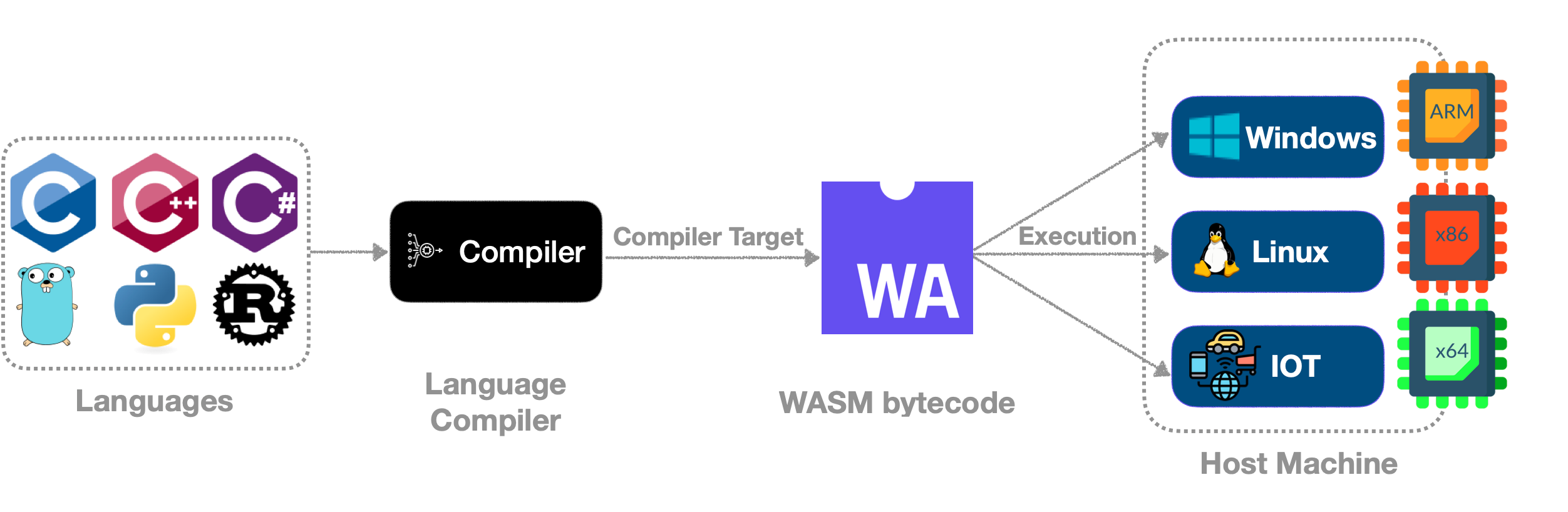
Figure 8 (from thesis): Layered architecture of WASI, highlighting libs and system call wrappers utilized by Wasm applications. The architecture shows application and libraries at the top, followed by WASI libc, libpreopen layer, system call wrapper, WASI implementation, and finally the host OS or runtime at the bottom.
WASI Capabilities
WASI provides standardized access to:
- Filesystem: read, write, list directories
- Environment: environment variables, command-line args
- Networking: TCP/UDP sockets
- Process control: process spawning, signaling
- System info: clock, random numbers
- Resource limits: memory, CPU constraints
WASI Example
// Rust code compiled to WASM
use std::fs;
use std::env;

fn main() {
    // WASI enables all these operations

    // Read environment variable
    let db_url = env::var("DATABASE_URL").unwrap();

    // Write to file
    fs::write("output.txt", "Hello from Wasm").unwrap();

    // Read from file
    let contents = fs::read_to_string("input.txt").unwrap();

    println!("Database: {}", db_url);
}
Without WASI, none of these operations would be possible in Wasm.
Wasm Runtimes
A Wasm runtime is software that:
- Loads Wasm bytecode
- Validates it (ensures no security violations)
- Compiles it to native code (JIT)
- Executes it with access to OS resources (via WASI)
- Manages sandbox isolation
Popular Wasm Runtimes
| Runtime | Focus | Features |
|---|---|---|
| Wasmtime | General-purpose | Robust, widely-used, CNCF project |
| WasmEdge | Cloud-native | Extensions, networking, ML support |
| Wasmer | Portability | Run anywhere, Python integration |
| Fermyon Spin | Microservices | Framework for building Wasm apps |
Layered Architecture
┌────────────────────────────────┐
│  Wasm Application              │
│  (compiled binary)             │
├────────────────────────────────┤
│  Wasm Runtime                  │
│  - Loader                      │
│  - Validator                   │
│  - JIT Compiler                │
│  - Sandbox Manager             │
├────────────────────────────────┤
│  Operating System              │
│  (kernel, system calls)        │
└────────────────────────────────┘
Challenges WebAssembly Solves
Serverless Computing
Before Wasm:
- AWS Lambda cold start: ~1 second
- Results in timeouts and poor UX for first invocations
- High latency for unpredictable workloads
With Wasm:
- Cold start: ~10-50 milliseconds
- Eliminates cold start penalties
- Enables true serverless scaling
Edge Computing
Before Wasm:
- Deploy containers to edge: Complex and resource-intensive
- Large bandwidth requirements for distribution
- High latency for startup
With Wasm:
- Tiny Wasm modules (few KB)
- Instant startup at edge locations
- Low bandwidth for distribution
- Better for real-time applications
Multi-Language Microservices
Traditional approach:
- Polyglot: Different languages create integration challenges
- Standardization: Container images are large regardless of language
- Resource waste: Overhead multiplied across services
Wasm approach:
- Compile any language to Wasm
- Consistent small binary size
- Standard runtime interface (WASI)
- Better resource utilization
IoT and Embedded
Before Wasm:
- Limited deployment options
- Languages restricted by platform
- High resource requirements
With Wasm:
- Run on IoT devices with limited resources
- Support multiple languages
- Portable across device architectures
- Efficient execution
Wasm vs. Containers Comparison
| Aspect | Containers | WebAssembly |
|---|---|---|
| Image Size | 100-500 MB | 1-10 MB |
| Startup Time | 1-10 seconds | 10-50 ms |
| Memory/instance | 50-200 MB | 1-10 MB |
| Isolation | OS-level | Language-level |
| Maturity | Very mature | Rapidly evolving |
| Ecosystem | Massive | Growing |
| Multi-language | No | Yes |
| Performance | ~100% overhead | ~5% overhead |
Real-World Use Cases
Microservices
Deploy lightweight Wasm microservices for APIs, data processing, business logic.
Serverless Functions
Replace Lambda/Cloud Functions with Wasm for sub-100ms cold starts.
API Gateways
Lightweight, fast Wasm-based proxies for request routing and transformation.
Data Processing
Stream processing, ETL pipelines, and batch jobs with minimal overhead.
Game Servers
Multiplayer game backends with predictable performance profiles.
ML Inference
TensorFlow inference on edge devices with Wasm + specialized runtimes.
The Future of Server-Side Wasm
Emerging Standards
- Component Model: Standardized Wasm component composition
- WASI 0.2+: Extended system interface capabilities
- Multi-threading: Better support for parallel execution
Adoption Trends
- Cloud platforms: AWS Lambda WebAssembly support
- Kubernetes: Native Wasm runtime support via containerd-shims
- Edge: Cloudflare Workers, Fastly Compute
- Enterprise: Integration with existing deployments
Challenges Ahead
- Ecosystem maturity: Growing but smaller than containers
- Debugging: Tools still evolving
- I/O heavy workloads: Current limitations for certain networking patterns
- Learning curve: New paradigm for developers
Conclusion
WebAssembly represents a fundamental shift in how we can build and deploy server-side applications. By combining near-native performance with portability, security, and resource efficiency, Wasm addresses some of the most pressing challenges in modern cloud computing.
While containers solved the “works on my machine” problem, WebAssembly goes further by solving the “efficient execution across any environment” problem. The combination of Wasm and WASI provides a powerful new toolkit for:
- Building faster serverless functions
- Deploying to edge computing environments
- Creating efficient microservices
- Supporting polyglot development
- Optimizing resource utilization
As the ecosystem matures and standardization continues, expect WebAssembly to play an increasingly central role in cloud-native architectures. The future of computing isn’t just containers – it’s a hybrid world where containers and WebAssembly coexist, each solving different problems optimally.
Ready to see how Kubernetes and WebAssembly combine to create a powerful microservices platform? Explore WebAssembly workload orchestration in our next article!
References
Based on “Exploring WebAssembly-Based Microservices Implementation & Deployment Methods in Kubernetes” by Micheal Choudhary (2024):
[1] “Made with WebAssembly,” [Online]. Available: https://madewithwebassembly.com/. [Accessed 26 October 2023].
[4] S. Hykes, “twitter.com,” 10 November 2023. [Online]. Available: https://twitter.com/solomonstre/status/1111004913222324225. [Accessed 12 February 2024].
[5] J. Beswick, “AWS: Operating Lambda: Performance optimization – Part 1,” Amazon, 26 April 2021. [Online]. Available: https://aws.amazon.com/blogs/compute/operating-lambda-performance-optimization-part-1/. [Accessed 22 February 2024].
[6] R. Matei, “Spin 1.0 — The Developer Tool for Serverless WebAssembly,” 22 March 2023. [Online]. Available: Spin 1.0 — The Developer Tool for Serverless WebAssembly. [Accessed 24 February 2024].
[31] “WebAssembly Developer Guide,” [Online]. Available: https://webassembly.org/getting-started/developers-guide/. [Accessed March 2023].
[32] “Node.js documentation,” March 2023. [Online]. Available: https://nodejs.org/api/wasi.html.
[33] https://webassembly.github.io/spec/core/bikeshed/, “WebAssembly Core Specification,” [Online]. Available: https://webassembly.github.io/spec/core/bikeshed/. [Accessed 23 February 2024].
[34] “WebAssembly.org portability,” [Online]. Available: https://webassembly.org/docs/portability. [Accessed 20 March 2023].
[35] A. Haas, A. Rossberg, D. L. Schuff, B. L. Titzer, M. Holman, D. Gohman, L. Wagner, A. Zakai and J. Bastien, “Bringing the web up to speed with WebAssembly,” 14 June 2017. [Online]. Available: https://doi.org/10.1145/3062341.3062363. [Accessed 10 March 2023].
[36] P. Hickey, “Lucet Takes WebAssembly Beyond the Browser,” 28 March 2019. [Online]. Available: https://www.fastly.com/blog/announcing-lucet-fastly-native-webassembly-compiler-runtime. [Accessed 1 February 2024].
[37] Surma, “https://shopify.engineering/javascript-in-webassembly-for-shopify-functions,” Shopify, 9 Ferbruar 2023. [Online]. Available: Bringing Javascript to WebAssembly for Shopify Functions. [Accessed 20 Ferbruary 2024].
[38] “Webassembly.org Security,” [Online]. Available: https://webassembly.org/docs/security/. [Accessed 25 March 2023].
[39] D. Gohman , “WASI: WebAssembly System Interface,” [Online]. Available: https://github.com/bytecodealliance/wasmtime/blob/main/docs/WASI-overview.md. [Accessed 14 May 2023].
[40] “WasmEdge Developer Guides,” [Online]. Available: https://wasmedge.org/docs. [Accessed 18 August 2023].
[41] “Fermyon Spin Developer Guide,” [Online]. Available: https://developer.fermyon.com/spin/index/. [Accessed 16 May 2023].